
Anti-Slavery International report: state-imposed forced labour of Uyghurs amounts to enslavement as a crime against humanity; businesses must exit the region
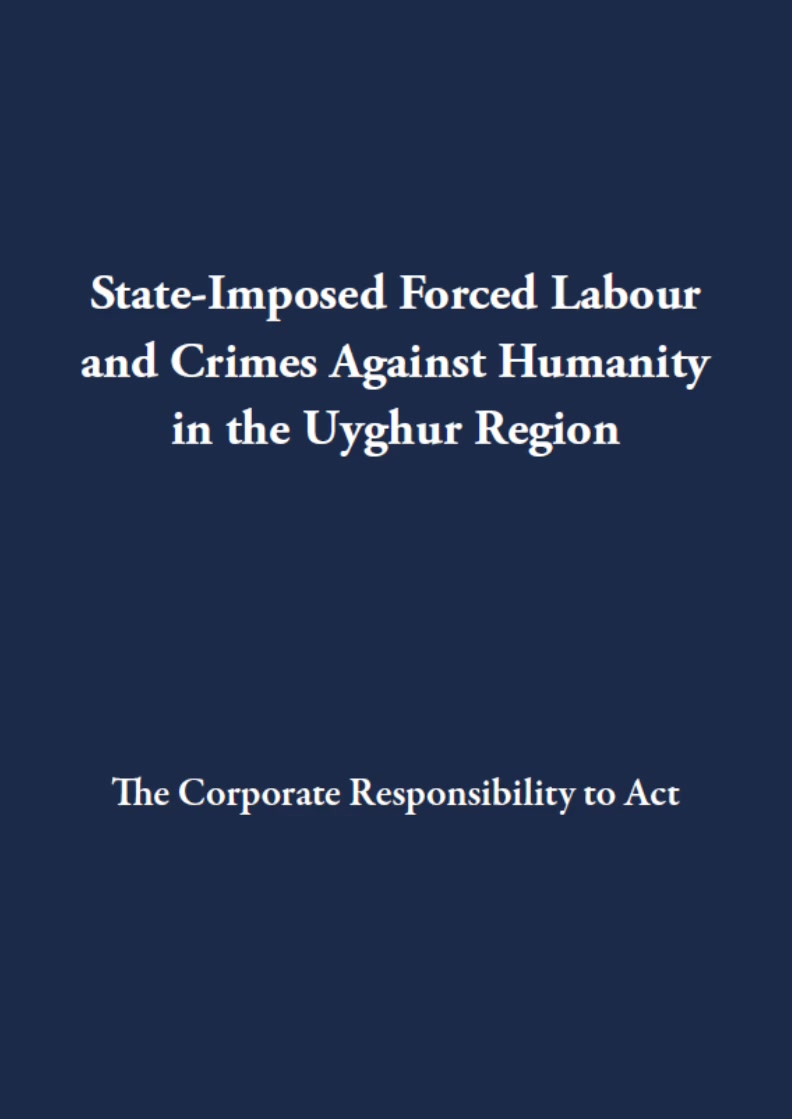
Anti-Slavery International published a new report on November 25, 2026, 'State-Imposed Forced Labour and Crimes Against Humanity in the Uyghur Region: The Corporate Responsibility to Act', which finds that the widespread and systematic state-imposed forced labour perpetrated by the Government of China against Uyghurs and other Turkic and Muslim-majority peoples constitutes the crime against humanity of enslavement under the Rome Statute of the International Criminal Court. The report finds that forced labour in internment camps, which peaked between 2017 and 2019, constitutes enslavement, and that so-called 'labour transfers', now the primary mechanism of state-imposed forced labour, also amount to enslavement in many instances, operating within a profoundly coercive environment. The forced labour enables a wider array of egregious abuses, including severe deprivation of physical liberty, torture, rape and other forms of sexual violence and persecution, which are themselves highly likely to constitute crimes against humanity. The report warns that foreign businesses operating in or sourcing from the Uyghur Region may be normalising, and therefore contributing to, the crime of enslavement, and calls on them to responsibly exit the region and terminate contracts with suppliers there. This record is graded 'under ongoing verification'. [1][2] (Update, November 27, 2026: the World Uyghur Congress welcomed the USTR's November 25 Section 301 investigation report identifying Uyghur forced labour as a factor in unfair competition, and cited this report. [3])
Why it matters
This record is worth keeping for three reasons. First, the grading has escalated: this is not a general condemnation but a legal analysis argued provision by provision under the Rome Statute — the report's conclusion is that state-imposed forced labour itself constitutes enslavement, not merely that it 'may' do so, giving governments and businesses a directly citable legal basis for action. In 2022 the UN Special Rapporteur on contemporary forms of slavery found that some instances 'may amount to enslavement as a crime against humanity, meriting a further independent analysis'; this report is the analysis that call asked for. Second, it names the mechanism of the present day: the internment-camp peak has passed, but 'labour transfers' are now the primary mechanism, and goods produced with them travel through supply chains across China — so the report extends the duty of heightened human rights due diligence to every business operating in or sourcing from anywhere in China, not only the Uyghur Region. That echoes this site's October 29 record of the US UFLPA entity listing of BGI Genomics and forms a trackable thread. Third, the report confronts an uncomfortable reality: global pressure on the persecution of Uyghurs has waned while the Chinese government has reduced the public visibility of its forced-labour systems; the report's publication is itself a reminder not to look away. Note: this record verifies that Anti-Slavery International published the report and its core conclusions; the report's legal findings are the conclusions of commissioned independent research, whose full evidentiary basis this site has not independently verified — hence the 'under ongoing verification' grading. [1][2]
Full report
Event card: Time — report published November 25, 2026 (London); forced labour in internment camps peaked between 2017 and 2019. Place — the Xinjiang Uyghur Autonomous Region of China (the 'Uyghur Region' in the report) and supply chains across China. Type — Uyghurs (group discrimination / forced labour). Status — ongoing (report published; responses from governments and businesses to follow). People involved — Uyghurs and other Turkic and Muslim-majority peoples. What happened — Anti-Slavery International commissioned independent research and published a report finding that state-imposed forced labour constitutes enslavement as a crime against humanity. Official response — no response from the Government of China to this report had been seen at the time of writing (the Chinese government consistently denies forced-labour allegations). Source — Anti-Slavery International press release and report page, November 25, 2026.
The report's core findings: According to Anti-Slavery International's press release of November 25, 2026, the new report, 'State-Imposed Forced Labour and Crimes Against Humanity in the Uyghur Region: The Corporate Responsibility to Act', finds that the widespread and systematic state-imposed forced labour perpetrated by the Government of China against Uyghurs and other Turkic and Muslim-majority peoples constitutes the crime against humanity of enslavement. Specifically, forced labour in internment camps, which peaked between 2017 and 2019, constitutes enslavement as a crime against humanity, as state authorities exercised powers of ownership over detainees; so-called 'labour transfers', which now function as the primary mechanism of state-imposed forced labour, operate within a profoundly coercive environment that includes threats of detention and associated violence, and in many instances this policy has resulted in the commission of the crime against humanity of enslavement. Assessed under the Rome Statute of the International Criminal Court, the report finds that the Government of China actively designed and implemented state-imposed forced labour policies as part of a widespread and systematic attack against the civilian population; the evidence shows that a key underlying motivation of the government is the targeting of the religious and cultural expression and identity of Uyghurs and other minoritised groups. [1][2]
Associated abuses: The report finds that state-imposed forced labour enables a wider array of egregious abuses such as severe deprivation of physical liberty, torture, rape and other forms of sexual violence and persecution. These abuses are often the consequence of enslavement, and in some cases the abuses are the means by which enslavement is achieved; these harms are highly likely to also constitute crimes against humanity. [1]
The warning and demands for business: The report finds that, given the allegations of a crime against humanity and the use of labour transfers beyond the Uyghur Region as a mechanism of state-imposed forced labour, every business operating in, or sourcing from, anywhere in China has a duty to conduct heightened human rights due diligence. Heightened human rights due diligence — and in fact any meaningful human rights due diligence — is currently impossible in the Uyghur Region because rightsholders cannot participate without fear of reprisal. The report warns that foreign businesses that operate in or source from the Uyghur Region, including locally incorporated subsidiaries, may be normalising, and therefore contributing to, the crime against humanity of enslavement. Businesses must therefore responsibly exit the Uyghur Region and terminate contracts with suppliers there. Anti-Slavery International also calls on governments to legislate and ensure businesses that are complicit in atrocity crimes are held accountable. [1]
What the organisation said: Patricia Carrier, Business and Human Rights Adviser at Anti-Slavery International, said: 'When businesses operate in places where crimes against humanity are being committed, their first responsibility is to the people affected, not to their profits. Companies have a moral obligation to remove themselves from situations where their presence or investments may contribute to suffering or injustice. And now, with this finding, there are legal implications that add further urgency to this obligation.' Cara Priestley, International and Thematic Advocacy Manager at Anti-Slavery International, said: 'The Uyghur Region is a major source of raw materials and manufactured goods, including cotton, textiles, and electronics. Due to the extensive use of labour transfers, goods produced with Uyghur forced labour may be found across China. This makes the entire country a high-risk area for business, not just the Uyghur Region.' Priestley added that the Government of China has reduced public visibility of its systems of state-imposed forced labour in recent years, that global pressure has since waned, and that 'now is not the time to look away.' [1]
Verification note: The core facts of this record — that Anti-Slavery International published this report on November 25, 2026, its core conclusions and its demands on business — come from the organisation's press release and report page; the report's legal findings are the conclusions of commissioned independent research, whose full evidentiary basis this site has not independently verified. The Government of China consistently denies forced-labour allegations, and no response to this report had been seen at the time of writing. This record is graded 'under ongoing verification' and will be updated on responses from governments and businesses. [1][2]
[Update, November 27, 2026] USTR Section 301 investigation and the World Uyghur Congress response: according to ANI on November 27, 2026, the World Uyghur Congress welcomed the Section 301 investigation report published by the Office of the United States Trade Representative on November 25, 2026 — “China's Acts, Policies, and Practices Relating to Structural Excess Capacity and Production in Manufacturing Sectors” — which identifies the use of Uyghur forced labour as a factor contributing to unfair competition and global market distortions. WUC President Turgunjan Alawdun said Uyghur forced labour is not simply an issue of unfair competition but a crime against humanity and an integral part of the ongoing Uyghur genocide, and called on governments and businesses to ensure that economic interests do not come at the expense of fundamental human rights. The WUC also cited the Anti-Slavery International report published on the same day. The above is the WUC's own statement and a summary of the USTR report, and has not been independently verified by this site. [3]
Primary sources
- Anti-Slavery International, November 25, 2026: 'New Anti-Slavery International report concludes that state-imposed forced labour of Uyghurs and other Turkic and Muslim-majority peoples constitutes a crime against humanity and businesses risk contributing to the crime' — the new report, 'State-Imposed Forced Labour and Crimes Against Humanity in the Uyghur Region: The Corporate Responsibility to Act', finds that the widespread and systematic state-imposed forced labour against Uyghurs and other Turkic and Muslim-majority peoples constitutes the crime against humanity of enslavement; forced labour in internment camps (peaking 2017–2019) and the now-primary 'labour transfers' amount to enslavement in many instances; associated severe deprivation of physical liberty, torture, rape and other sexual violence and persecution; businesses must responsibly exit the Uyghur Region and terminate local supplier contracts, and governments should legislate to hold complicit businesses accountable.
- Anti-Slavery International, November 2026 report page: 'State-Imposed Forced Labour and Crimes Against Humanity in the Uyghur Region' — the organisation commissioned this report in 2025, seeking an independent analysis of the role of state-imposed forced labour in the context of crimes against humanity in the Uyghur Region and guidance on businesses' responsibilities; in 2022 the UN Special Rapporteur on contemporary forms of slavery found that some instances of this state-imposed forced labour 'may amount to enslavement as a crime against humanity, meriting a further independent analysis', and this report provides that analysis.
- ANI (via Manchester News), November 27, 2026: “WUC urges global action against Uyghur forced labour after US trade investigation findings” — the World Uyghur Congress welcomed the USTR's November 25 Section 301 investigation report identifying Uyghur forced labour as a factor in unfair competition and global market distortions, and cited the Anti-Slavery International report published the same day; the WUC president called forced labour a crime against humanity. This site has checked the full text of the report.
The links above point to the original publishers of the cited reports or articles. Their conclusions are attributed in the text and do not amount to independent verification of every fact by this site.