
Hainan rights defender Wu Kongda spends his 51st birthday in prison; Human Rights in China urges protection of his correspondence, family-visit and appeal rights
Wu Kongda, a former teacher from Hainan, spent his 51st birthday in prison on November 25, 2026, with 134 days left of his sentence. He was sentenced in March 2024 to three years and six months for “inciting subversion of state power,” with his term running until April 9, 2027; he is serving it at Meilanxu Prison in Haikou. Human Rights in China issued a statement the same day calling for his rights to correspondence, family visits and appeals to be protected, saying that in 2025 he repeatedly wrote home that he could not meet his family and that state security officers asked relatives to tell his friends not to send him letters. Those claims about restrictions come from the organisation's account and have not been confirmed as continuing into November 2026; the facts of the conviction have been checked against the CECC Political Prisoner Database. Status: under ongoing verification. [1][2][3]
Why it matters
This record is worth publishing for three reasons. First, Wu Kongda's case is a representative case of punishment for speech: a rural teacher was sentenced to three and a half years for forwarding rights-related information in WeChat groups and expressing political views, and the CECC Political Prisoner Database records the full judicial timeline from detention to sentencing, so the basic facts of the case can be checked. Second, the birthday comes as his term nears its end — 134 days remain — bringing the case back into public view, and whether his family can write to and visit him bears directly on his conditions in the final stretch of his sentence. Third, the communication rights raised by Human Rights in China's appeal have wider relevance: whether prisoners can receive letters, meet their families and file appeals is a key measure of prison conditions. To be clear: this record verifies the basic facts of the case and the two new disclosures of November 25 (the birthday and the appeal); the claims about restrictions on correspondence and visits in 2025 are reported second-hand and have not been independently verified, so it is published as under ongoing verification. [1][2][3]
Full report
Event card: Time — November 25, 2026, Wu Kongda's 51st birthday (Human Rights in China issued its appeal the same day); Place — Meilanxu Prison, Haikou, Hainan Province (Yanfeng, Meilan District); Wu is originally from Longhu, Ding'an County; Type — speech and online expression; Status — sentenced (three years and six months in March 2024, term running until April 9, 2027, 134 days remaining; now serving in Ward 6 of Meilanxu Prison); People involved — Hainan rights defender Wu Kongda (former teacher at Longhu Township Central School, Ding'an County) and his family; Account — Wu had long followed and shared material about constitutional democracy and rights advocacy and repeatedly raised views with his school and the government; at the end of June 2023 he was taken to a police station for forwarding information in a WeChat group about the forced relocation of rights lawyers Wang Quanzhang and Li Heping and the case of He Fangmei, and was then administratively detained for 15 days; in October 2023 he was criminally detained on suspicion of “inciting subversion of state power,” then formally arrested and indicted; on January 29, 2024 the Haikou Intermediate People's Court tried him — Wu pleaded not guilty and no verdict was announced that day; in March 2024 he was reported to have been sentenced to three years and six months, and the appeal court upheld the sentence; from 2025 his correspondence and family visits were reportedly restricted (see below); Official response — as of publication, no public response from the prison or the court to the birthday or the claims about restricted correspondence had been seen; Sources — Weiquanwang report of November 25 [1], Human Rights in China statement of November 25 (via an English summary) [2], CECC Political Prisoner Database [3].
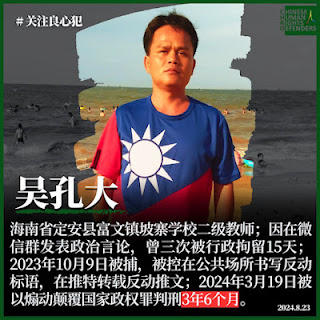
Who Wu Kongda is and how he was sentenced: Wu Kongda was born on November 25, 1975 and was a teacher at Longhu Township Central School in Ding'an County, Hainan, using the WeChat names “Tian Hui Zai Lan,” “Yao Shan Hun” and “Hai Tang Xue Lei.” According to Weiquanwang, he had long followed and shared material about constitutional democracy and rights advocacy and repeatedly raised views with his school and the government. At the end of June 2023, after forwarding information in a WeChat group about the forced relocation of rights lawyers Wang Quanzhang and Li Heping and the case of He Fangmei, he was taken to a police station and administratively detained for 15 days. On October 9, 2023 (CECC Political Prisoner Database record; Weiquanwang says October 10), he was criminally detained on suspicion of “inciting subversion of state power,” and was formally arrested on October 30. On January 29, 2024 the Haikou Intermediate People's Court tried his case; Wu argued that while some of his remarks may have been inappropriate, they were an exercise of the freedom of speech guaranteed by the Constitution, and pleaded not guilty; no verdict was announced that day. On March 19, 2024 (CECC record; Weiquanwang says it learned of the sentence in March), he was sentenced to three years and six months in prison and four years' deprivation of political rights, with his term running until April 9, 2027; his appeal was rejected and the sentence upheld. He was previously held at the Haikou No. 2 Detention Centre and now serves his sentence at Meilanxu Prison in Haikou. Human Rights in China links his imprisonment to his online political expression and to writing protest slogans in public places. [1][2][3]
The birthday and the claims about restricted correspondence: on November 25, 2026, Weiquanwang reported that Wu Kongda was spending his 51st birthday in prison, with 134 days left of his sentence. Human Rights in China issued a statement the same day calling for his rights to correspondence, family visits and appeals to be protected, saying that from April 2025 Wu repeatedly wrote home that he could not meet his family, without explaining why, and that in August that year state security officers asked relatives to tell his friends not to send him letters or postcards. Those claims about restrictions come from Human Rights in China's account; this site has obtained no original family letters, prison response or independent record, and cannot confirm whether any such restrictions remain in effect in November 2026. The record states that limitation as it stands and draws no inference beyond the evidence. [2]
Verification note: the parts of this record that have been verified — Wu Kongda's identity, detention, trial, sentence and term — match the CECC Political Prisoner Database (Record 2024-00104): criminal detention on October 9, 2023, trial at the Haikou Intermediate People's Court on January 29, 2024, sentence of three years and six months plus four years' deprivation of political rights on March 19, 2024, term ending April 9, 2027; the newly disclosed parts — the 51st birthday and Human Rights in China's appeal — come from the November 25 Weiquanwang report and Human Rights in China's statement of the same day (via an English summary); the parts not verified — the specific circumstances of the reported restrictions on correspondence and family visits in 2025 and whether they continue — rest on a single second-hand account, with no court judgment, prison record or original family letter to support them; no official response had been seen as of publication. Status: under ongoing verification. [1][2][3]
Primary sources
- Weiquanwang, November 25, 2026: 'Hainan rights defender Wu Kongda spends his 51st birthday in prison after being sentenced to three years and six months' — on November 25, 2026 Wu spent his 51st birthday in prison, with 134 days left of his sentence; born November 25, 1975, formerly a teacher at Longhu Township Central School, Ding'an County; at the end of June 2023 he was taken to a police station and administratively detained for 15 days for forwarding information in a WeChat group about the forced relocation of Wang Quanzhang and Li Heping and the case of He Fangmei; criminally detained on October 10, 2023 on suspicion of “inciting subversion of state power,” then arrested and indicted; tried at the Haikou Intermediate People's Court on January 29, 2024, pleading not guilty with no verdict announced that day; reported in March 2024 to have been sentenced to three years and six months, term ending April 9, 2027, appeal upheld; now serving in Ward 6 of Meilanxu Prison, Haikou. The original was republished by TNT Daily; the link points to the republished text.
- Human Rights in China, November 25, 2026 (Chinese-language post, via an English summary): 'HRIC Highlights Wu Kongda's 51st Birthday in Prison' — marking Wu's 51st birthday on November 25, 2026, Human Rights in China called for his rights to correspondence, family visits and appeals to be protected; it said that from April 2025 Wu repeatedly wrote home that he could not meet his family, and that in August that year state security officers asked relatives to tell his friends not to send letters or postcards; it links his imprisonment to his online political expression and to writing protest slogans in public places. The summary notes that the claims concern 2025, that the material does not establish whether the restrictions remain in effect in November 2026, and that the two nonofficial rights-advocacy sources may overlap, with no court judgment, prison record or original family letter available.
- Congressional-Executive Commission on China (CECC) Political Prisoner Database, Record 2024-00104: Wu Kongda — born November 25, 1975, teacher in Hainan; criminally detained on October 9, 2023 on suspicion of “inciting subversion of state power,” held at the Haikou No. 2 Detention Centre, formally arrested on October 30; tried at the Haikou Intermediate People's Court on January 29, 2024 and sentenced on March 19, 2024 to three years and six months in prison and four years' deprivation of political rights; the authorities alleged he had circumvented internet restrictions to access foreign websites and expressed dissatisfaction with China's political system and policies; the case raises UDHR Articles 19 (freedom of opinion and expression) and 21 (civic participation).
The links above point to the original publishers of the cited reports or articles. Their conclusions are attributed in the text and do not amount to independent verification of every fact by this site.